
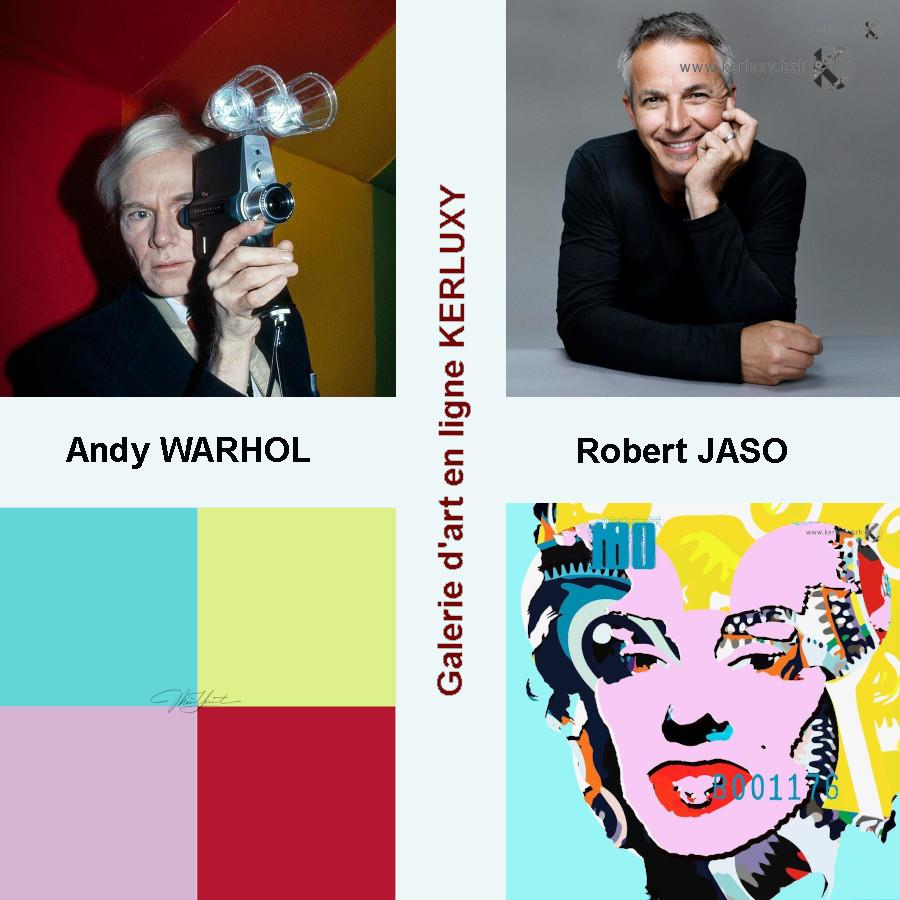
Marilyn MONROE, Andy WARHOL & Robert JASO : stable image or fragmented one?
"Reworked Icons" Art Collection - I
Marilyn MONROE, Andy WARHOL & Robert JASO: a complete image or a fragmented one?
In ANDY WARHOL’s work, the image appears in a state of near-permanent stability. The blue background establishes a uniform depth. The blonde hair, rendered as a compact mass, outlines the silhouette. The face, unified in a continuous pink, reveals no internal fractures. The red, sharply defined mouth acts as an anchor point, while the eye shadow echoes the blue of the background, creating chromatic continuity.
Nothing spills over. Every area is contained. The image is built from solid blocks of color, from closed surfaces, without interference.
This structure allows for an immediate interpretation. The face is presented in its entirely, without variation or distortion. The color does not fragment; it stabilizes. It constructs an image that holds its form, fully legible, fully present.
Against this backdrop of stability, ROBERT JASO’s work introduces a gradual shift.
The background retains the same blue, the hair remains blonde, and the face takes on a predominantly pink hue. The overall structure is recognizable. But this continuity is immediately disrupted by discontinuities.
The pink of the face is no longer uniform. It is fragmented, marked by variations. The areas no longer close perfectly. The image no longer holds together as a single surface.
Around the head, mechanical forms emerge. They do not accompany the face; they cut across it. A structure intervenes, external to the portrait. Unity disappears. The image becomes an assemblage.
This fragmentation is reinforced by the presence of a code at the bottom. This marking, resembling a serial number, places the image within an industrial context. But unlike a standardized reproduction, it does not stabilize anything. On the contrary, it emphasizes the constructed, almost unstable nature of the whole.
The juxtaposed colors no longer blend completely. They coexist. It is their proximity that produces the face, not their continuity.
The difference between the two practices thus becomes visible without being demonstrative.
In Warhol’s work, color unifies. It produces a stable, instantly recognizable image, held in a fixed state.
In Jaso’s work, color fragments. It introduces gaps, tensions, and points of rupture that prevent the image from closing in on itself.
This is not a stylistic variation. It is a shift in the image’s status. On one hand, a contained image, constructed with coherence. On the other, an image that is traversed, recomposed, maintained in a state of unstable equilibrium.
What is at play here is not a head-on opposition, but a silent transformation. The image does not disappear. It shifts modes. It moves from a unified surface to a fragmented structure. And it is in this shift that the gaze pauses.
Mari Yvenat
Andy Warhol: the Enigma of the visible
The BMW M12 Art Car by Andy Warhol
Visit the Andy Warhol exhibition at SFMoMA
©Getty Images
©Mari Yvenat