
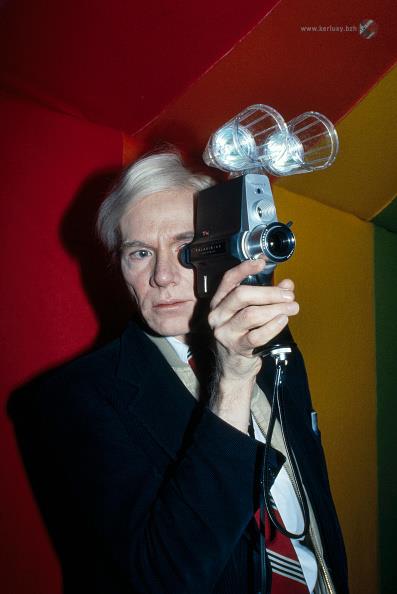
Andy WARHOL, the Enigma of the visible
"Reworked Icons" Art Collection - I
Andy Warhol: the birth of an icon and a revolution in the way we see.
Andy Warhol occupies a unique place in the history of contemporary art, not only as a leading figure of Pop Art, but as an artist who profoundly transformed the way we perceive images. His work cannot be fully understood without tracing the origins of his vision, the very source of his distinctive sensibility toward the visible word.
Born in Pittsburgh, Pennsylvania, in 1928, into a modest family of Slovak immigrants, Warhol grew up in an environment where images were omnipresent. Newspapers, magazines, reproductions, commercial illustrations: the visual everyday world became his field of observation at a very early age. As a child, Warhol did not merely look; he collected, cut out, and preserved, as if he already sensed that images possessed a life of their owns, independent of what they represented.
This childhood, often described as quiet and introspective, was formative. It did not foster a heroic imagination, but rather a keen attention to the ordinary. Where others sought the extraordinary, Warhol learned to see repetition, banality, and the silent flow of forms. A can of soup, a printed face, an advertisement in a magazine are not secondary elements: they become visual structures in their own right.
This early relationship with images establishes a logic that would run through his entire career. Warhol never sought to pit art against everyday life, but rather to understand their continuity. He realized very early on that the modern world is no longer composed solely of objects, but of images of objects, already transformed, already disseminated, already reproduced.
When he moved to New York and began his career in illustration and advertising, this intuition found concrete expression. Far from breaking with this commercial world, he absorbed its codes. Graphic design, mechanical reproduction, and mass production gradually became the tools of his artistic language. This transition was essential: Warhol did not "leave" mass visual culture; he shifted it into the realm of art.
Following the emergence of Pop Art in the 1960s, this approach took on a radical form. Campbell's soup cans, celebrity portraits, logos, and industrial objects entered the artistic realm without any narrative transformation. They are not interpreted: they are presented, repeated, and aligned. The artwork no longer tells a story; it exposes a system of visibility.
In this system, repetition becomes a fundamental language. It serves not to illustrate, but to deactivate the idea of uniqueness. Each image appears identical and yet slightly different, as if the variation itself became the subject. The viewer's gaze is no longer invited to discover, but to recognize, and then to question that recognition.
The famous portraits of Marilyn Monroe or other media figures do not function as traditional portraits. They are surfaces of circulation, where identity dissolves in reproduction. The individual disappears in favor of the icon, and the icon itself becomes a motif that can be reproduced infinitely.
The aesthetic of repetition has its roots in Warhol's original perspective: a perspective that does not establish hierarchies, but simply observes. The boy from Pittsburgh, fascinated by printed images and everyday objects, never ceases to be present in the artist he becomes. Quit simply, this perspective has shifted: it became a method, then a system, then a work of art.
Understanding Andy Warhol, therefore, does not mean searching for a hidden intention or a secret psychology. It means understanding a way of seeing. A way of seeing that accepts that the image sometimes precedes reality, that repetition replaces the original, and that everyday life is already saturated with visual forms.
From this perspective, his work belongs not only to the history of art, but to a profound transformation of our relationship to the visible. It forces us to acknowledge that we live in a world where everything is already an image, and where art perhaps consists simply of making this obvious fact perceptible.
Mari YVENAT
Visit the Andy Warhol exhibition at SFMoMA
The BMW M12 Art Car by Andy Warhol
©Getty Images