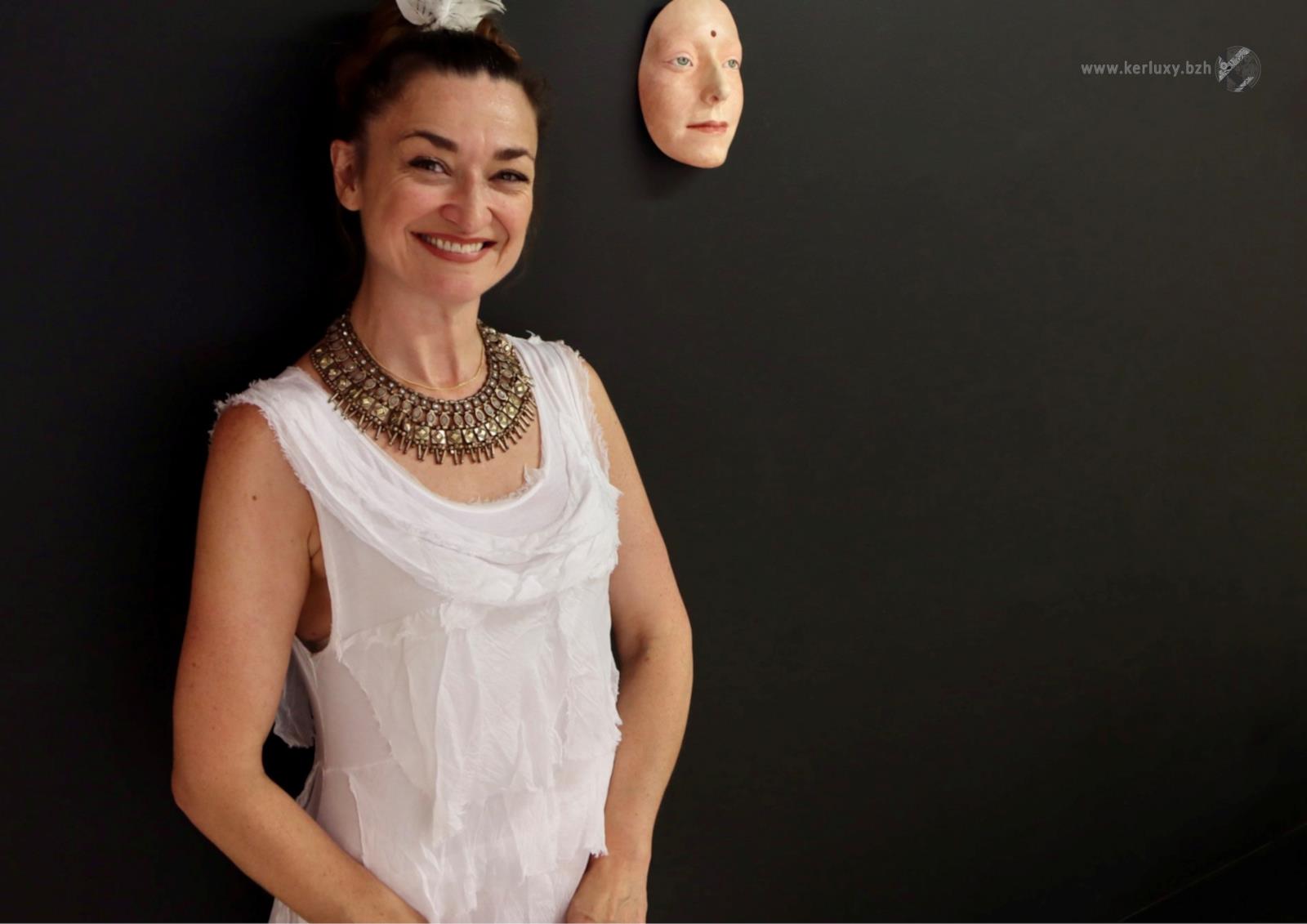
Sido
For Sido, sculpture begins where certainties fade away.
Her work seeks that suspended moment when a human being holds their breath, just before everything can tip over. A moment of extreme intensity, where time seems to disappear and only the essential remains: a body, an emotion, a vulnerability, a strength.
With a profoundly multidisciplinary background, Sido explored theater, drawing, painting, life drawings, architecture, costume design, and the performing arts before finding in sculpture the means of expression capable of giving form to the characters that inhabited her imagination.
Her perspective was shaped by her contact with the body. As a model, she posed for photographers, painters, and sculptors. As an actress, she learned to observe the emotions, attitudes, and imperceptible tensions that transform a face or a gesture. This experience of the lived body now nourishes a sculpture where anatomical precision is never an end in itself: it becomes the language of emotion. Sido also draws inspiration from the world of dreams, outsider art, expressionism, and his reflections on the human psyche. His encounter with Alejandro Jodorowsky and his discovery of psychomagic, in particular, opened up a territory where the real and the symbolic can meet.
Dreamlike Realism
It is from this confrontation between reality and imagination that Sido calls “dreamlike realism” is born.
She deliberately blurs sensory reference points. Reality and illusion are placed on the same plane, creating a double: is what we see flesh, a dream, a presence, or an apparition?
Her sculptures thus give a central place to questioning. They initially attract the viewer with their physical presence, then gradually establish a different relationship with the gaze: a moment of suspension, of astonishment, sometimes of unease.
The human body appears in all its ambivalence. Sido seeks a balance between an almost sacred humanity and a more instinctive animality, between beauty and flesh, power and vulnerability, life and its finitude.
Many of her works are self-portraits in the most intimate sense of the term. They arise from her experiences, her emotions, and the need to understand what constitutes the human being.
For Sido, each sculpture is thus an attempt to answer an essential question: who are we when everything else disappears?
From Theater to Sculpture
Her artistic journey did not follow a linear academic path.
Sido was surrounded by creativity from an early age. Her godmother, a painter and sculptor, introduced her to the art world, while her mother, a seamstress and embroiderer, instilled in her an appreciation for precision, patience, and the importance of craftsmanship.
She initially studied advertising and communication in Paris, followed by architecture at the Ecole des Beaux-Arts. Ultimately, however, the stage became her calling. In the 1990s, she became an actress and immersed herself in Paris’s artistic circles.
At the same time, she explored painting, drawing, and sculpting. She created her first pieces, took part in exhibitions, and received her first commission for a mural.
Theater also allowed her to develop another facet of her practice: character creation. She designed costumes and makeup for the roles she played and participated in interdisciplinary projects that blended visual art, character work, and performance.
Gradually, her artistic universe expanded to encompass “outsider art”, expressionism, tribal art, and art therapy, while her interest in the mechanisms of dreams and the psyche became a central element of her work.
The body as Material and Language
When she discovered the techniques used to create props and hyper-realistic special effects for cinema, Sido found the technical means she had been lacking to bring the forms and creatures of her imagination to life.
Then came a modeling class.
She was asked to sculpt a portrait of the person sitting before her. For Sido, the realization was immediate: her experience as a model, actress, and artist had already taught her to view the body in a different light.
Structure, lines of force, material, everything became a form of language.
She then chose to devote herself entirely to sculpture.
Since her first exhibitions in Paris, her work has pursued this same quest: to capture within the material that aspect of the human being which cannot be expressed in any other way.
See the creative works